How can YouTubers sound clearer to a US audience without hiring a narrator?
Accent Changer Team
Convert your own recording. YouTubers who want to sound clearer to a US audience do not have to hire a narrator or re-film. A speech-to-speech accent converter takes the voice track from your video, shifts pronunciation toward American English, and keeps your timbre, pacing, and personality. You stay on camera; only delivery changes.
That is a different product category from text-to-speech. TTS gives you a new voice reading a script. Accent conversion gives you your performance with adjusted vowels and consonants — which is what viewers expect when they see your face.
Why narrators are not the only option
Hiring a US narrator works when you want a completely different voice. It fails when:
- Your face is on screen and a mismatched voice breaks trust
- B-roll and screen recordings are synced to your cadence
- You have dozens of videos and narration fees add up fast
- You like your energy but want clearer vowels for US listeners
Post-production accent conversion solves the last case. You film once, export audio, convert, and lay the new track under your edit — the same change accent online workflow creators use between full timeline passes.
The YouTube-friendly workflow
| Step | What you do |
|---|---|
| 1 | Export speech from Premiere, DaVinci, or CapCut |
| 2 | Upload to a speech-to-speech tool |
| 3 | Select American (or neutral US) as target |
| 4 | Download and replace the audio track in your timeline |
accentchanger.com handles upload, accent selection, preview, and MP3 download in the browser — no install required.
Audio-only vs full video
For talking-head videos, converting the audio track and re-attaching it in your editor is usually enough. Viewers hear clearer US English while your face and cuts stay the same.
If lip movement matters for close-ups, see convert accent on video and keep lip-sync usable — timing preservation is part of the speech-to-speech approach, but extreme close-ups deserve a extra preview pass.
Target accent choice
The American accent changer profile is the typical pick for US YouTube audiences. You are not switching language — same script, same meaning, clearer delivery for listeners used to General American vowels.
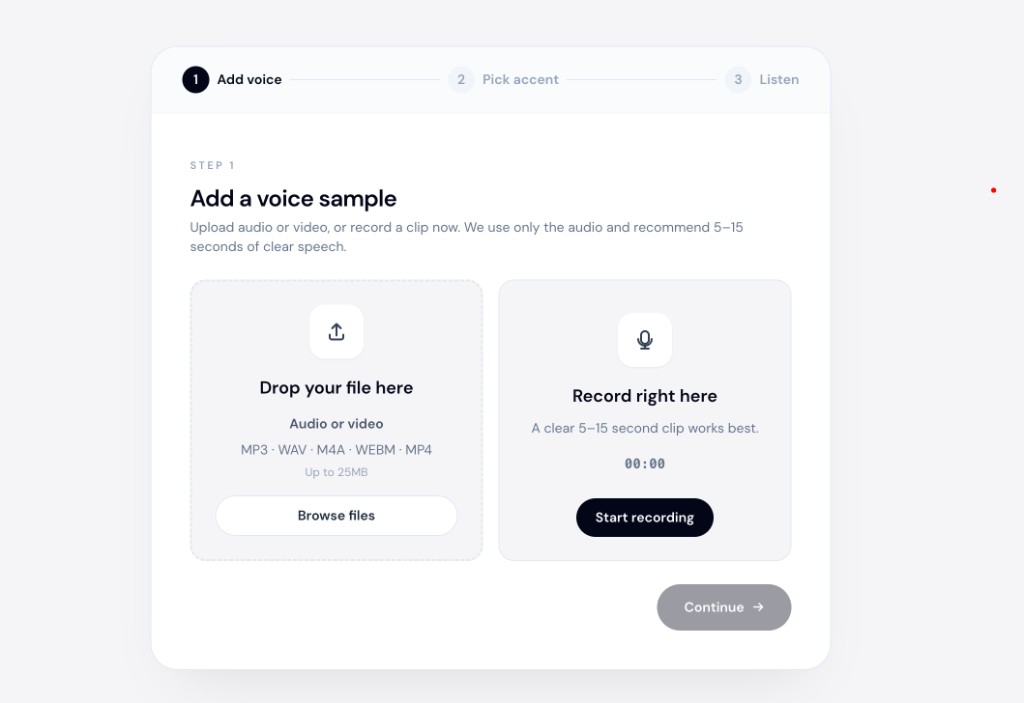
The video accent changer workflow at accentchanger.com accepts common video formats; the speech track is what gets converted.
What to avoid
- Stock TTS over your face — viewers notice immediately
- Converting over loud background music — isolate voice first
- Expecting one click to fix a noisy hotel room — clean source audio wins
Bottom line
YouTubers sound clearer to US audiences without a narrator by converting their own voice track with speech-to-speech AI, then swapping it back into the edit. You keep your on-camera identity.
Try a 30-second clip at accentchanger.com before batch-processing a backlog. For the same post-production pattern on long-form audio, see how podcasters change accent after recording.