Can AI reduce my accent for interviews without months of coaching?
Accent Changer Team
Partly yes — with an important split. AI can soften strong accent patterns on recorded interview answers in minutes. It cannot yet replace you in a live video call where the interviewer hears your real-time speech.
That distinction saves a lot of wasted effort. Job seekers often download coaching apps or upload practice clips to the wrong category of tool. Knowing which interview stage you are in matters more than any single product name.
Where AI helps immediately
AI accent conversion shines when the employer evaluates audio or video you submit, not a spontaneous back-and-forth:
- One-way video interviews (record your answers, upload to their platform)
- Portfolio or intro reels attached to applications
- Practice playback — hear how your script could sound with clearer American or British delivery
- Pre-recorded screening answers you can re-do or post-process before submitting
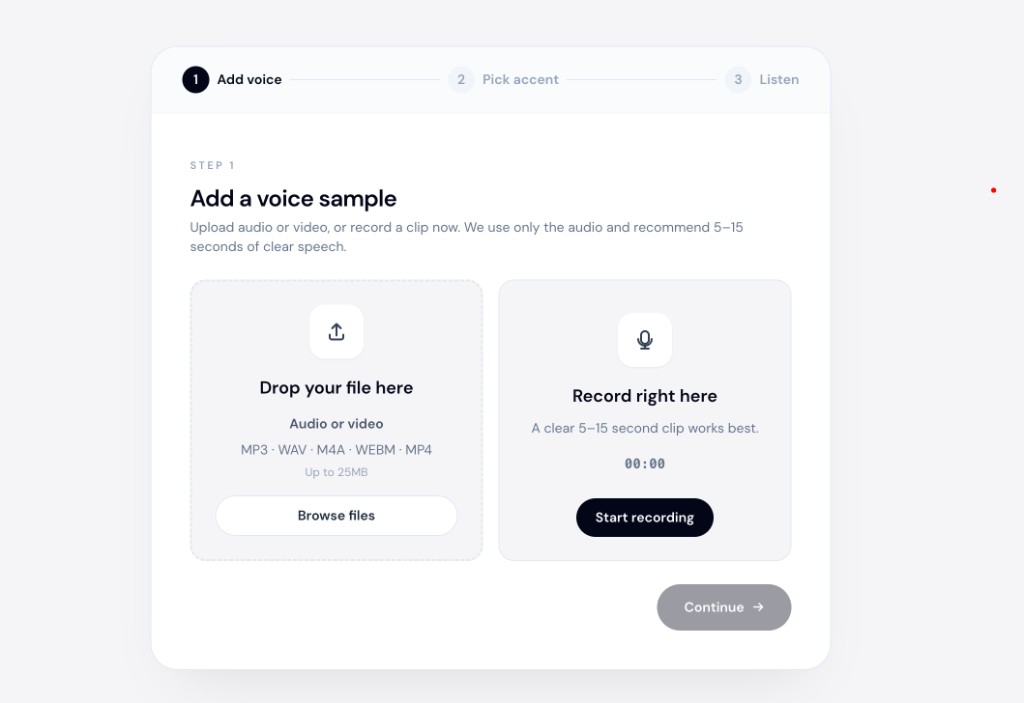
In these cases, an accent reduction tool works on the file you already captured. Upload, pick a target profile, preview, download — often faster than scheduling another coaching session.
Where AI does not replace coaching
Live interviews — phone screens, pair programming with spoken explanation, panel Q&A — require you to speak clearly in the moment. Browser-based converters process files; they do not run as a real-time Zoom filter (that is a different, rarer product category).
For live performance, short focused practice still wins:
- Record yourself answering common questions, then listen for clarity (not perfection)
- Drill problem sounds (th, r/l, vowel length) for ten minutes, not two hours
- Use AI output as a reference ear, not a crutch during the call
Think of AI as post-production for submissions, and coaching or self-drill as rehearsal for the room.
A practical hybrid plan (two weeks, not six months)
You do not need a semester of accent classes to improve interview outcomes. Try this sequence:
Week 1: Fix what employers actually hear
- List the five questions you get most often.
- Record clean answers (quiet room, phone or USB mic).
- Run one sample through accentchanger.com with an American or British target — compare before and after.
- Note specific sounds that still feel off in live speech; those become your drill list.
Week 2: Live readiness
- Practice answers out loud daily — timed, standing up, as if on camera.
- For one-way submissions, use the clearer converted file if the platform allows edited audio.
- Do one mock interview with a friend; score clarity, not accent elimination.
This is weeks of targeted work, not months of open-ended coaching — and AI shortens the feedback loop on recorded material.
What hiring managers usually care about
Most interviewers prioritize intelligibility and confidence over sounding like a native speaker. Heavy accent is rarely the disqualifier; unclear stress, rushed consonants, or losing the thread is.
AI conversion can make pre-recorded answers easier to follow. It cannot inject confidence — that still comes from knowing your stories cold.
Tools to use (and avoid)
Use:
- Speech-to-speech accent conversion for submitted clips
- Reduce accent online workflows when you need a quick browser test
- Mirror practice with converted audio as a pronunciation model
Avoid:
- Expecting a live call filter from a file-based tool
- Submitting obviously synthetic TTS instead of your voice — employers want you
- Replacing interview prep content (STAR stories, metrics) with accent work alone
Bottom line
AI can reduce accent patterns on interview recordings without months of coaching — especially for async video applications. For live conversations, combine short daily speaking practice with AI only where you control the file. Use conversion to ship clearer submissions; use rehearsal to show up clear in the room.